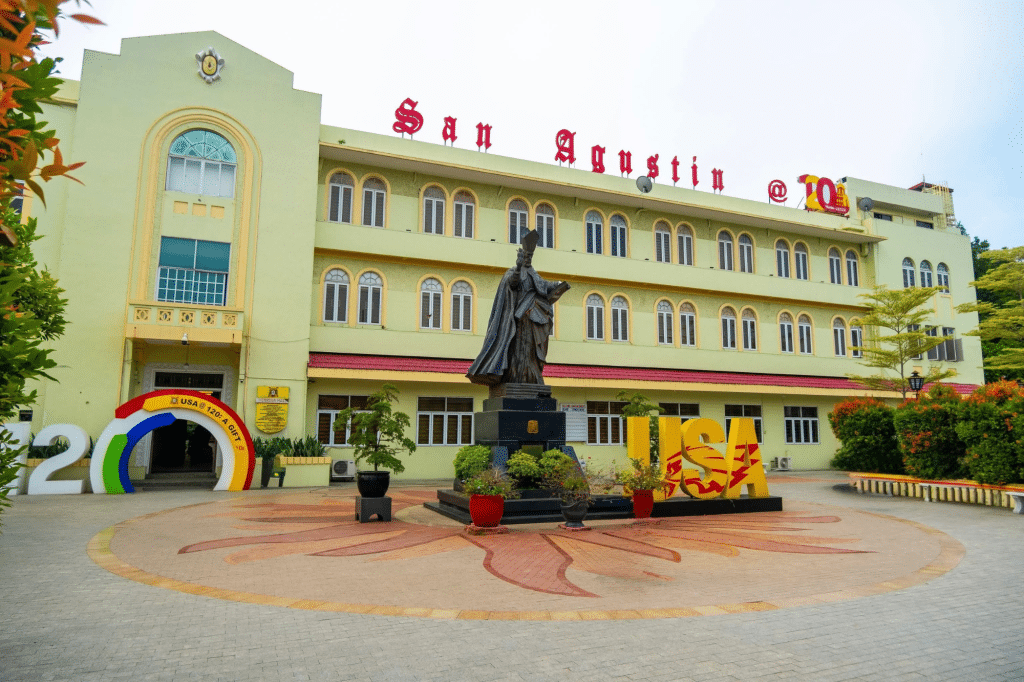
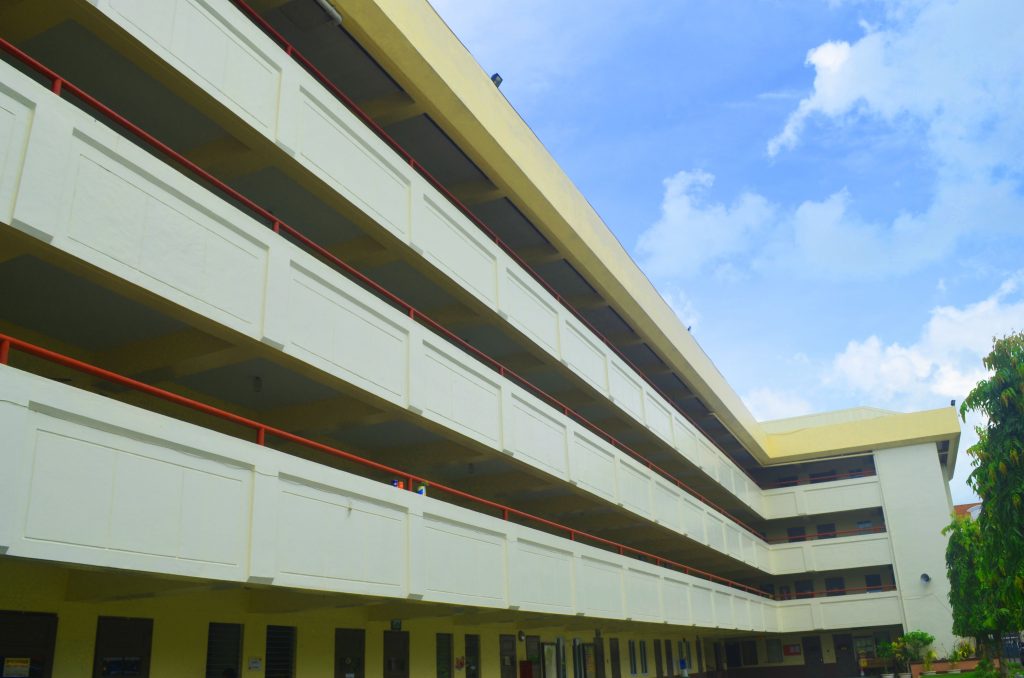
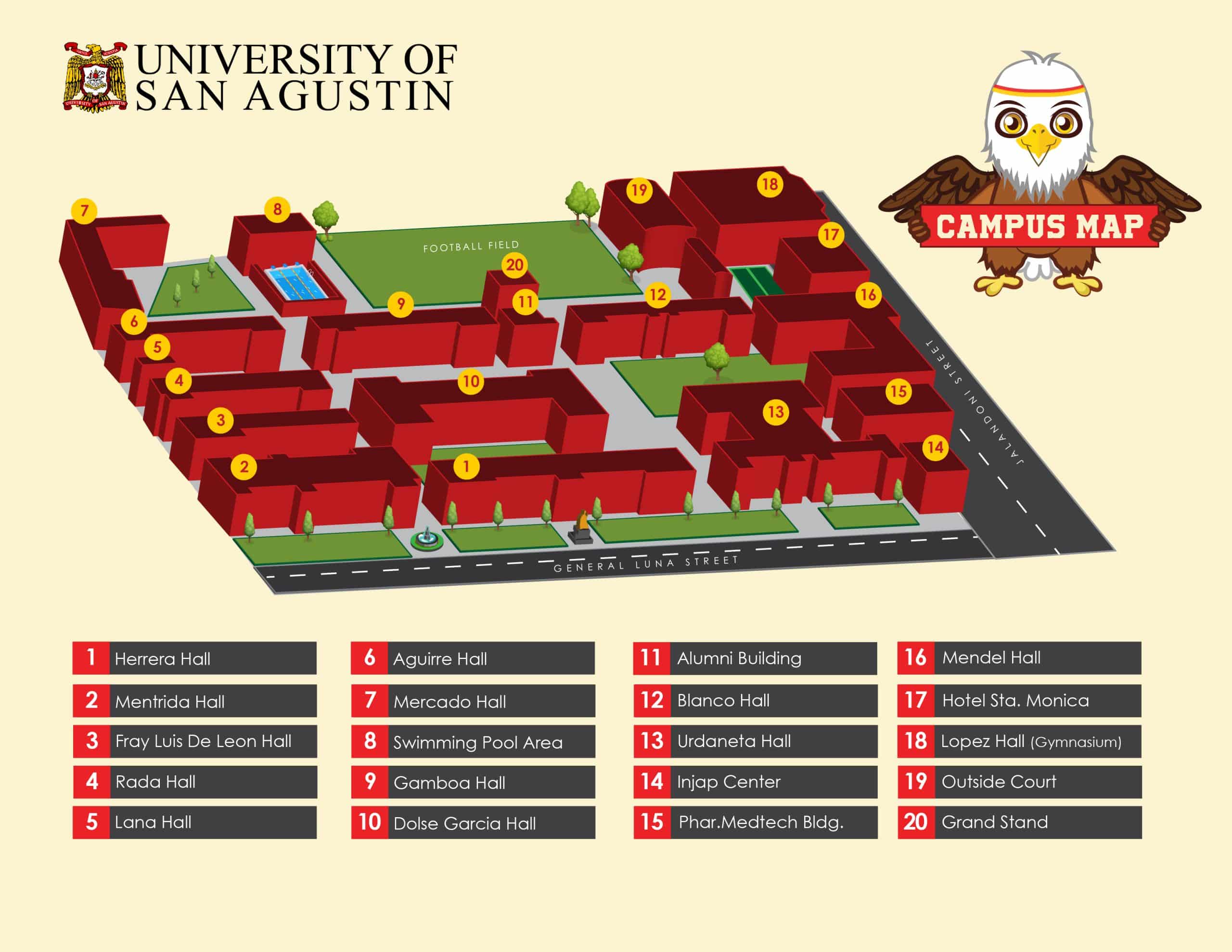
The University of San Agustin in Iloilo City was founded by the Augustinian friars in 1904 under the inspiration of St. Augustine, Doctor and Father of the Church. The main campus is located at General Luna St, Iloilo City, Province of Iloilo.
Initially, the institution was opened as an elite school for boys known as Colegio de San Agustin on July 12, 1904. The institution evolved from an exclusive school for boys into one leading to a degree in Arts, which later on has become a premier learning center of excellent programs in diverse fields, encompassing science and arts, technology, commerce, law, health and related science, theology, and other disciplines, which is in keeping with the Augustinian philosophy on education.
The growth of the University accelerated after the school was conferred its university status in 1953, making it the first university in Western Visayas. In the succeeding decade, massive investments in infrastructure enabled the University to open new programs and cater to a larger number of students mostly coming from the Western Visayas Region. In 2004, the University was granted autonomous status by the Commission on Higher Education (CHED), a recognition of its institutional excellence and commitment to quality education.
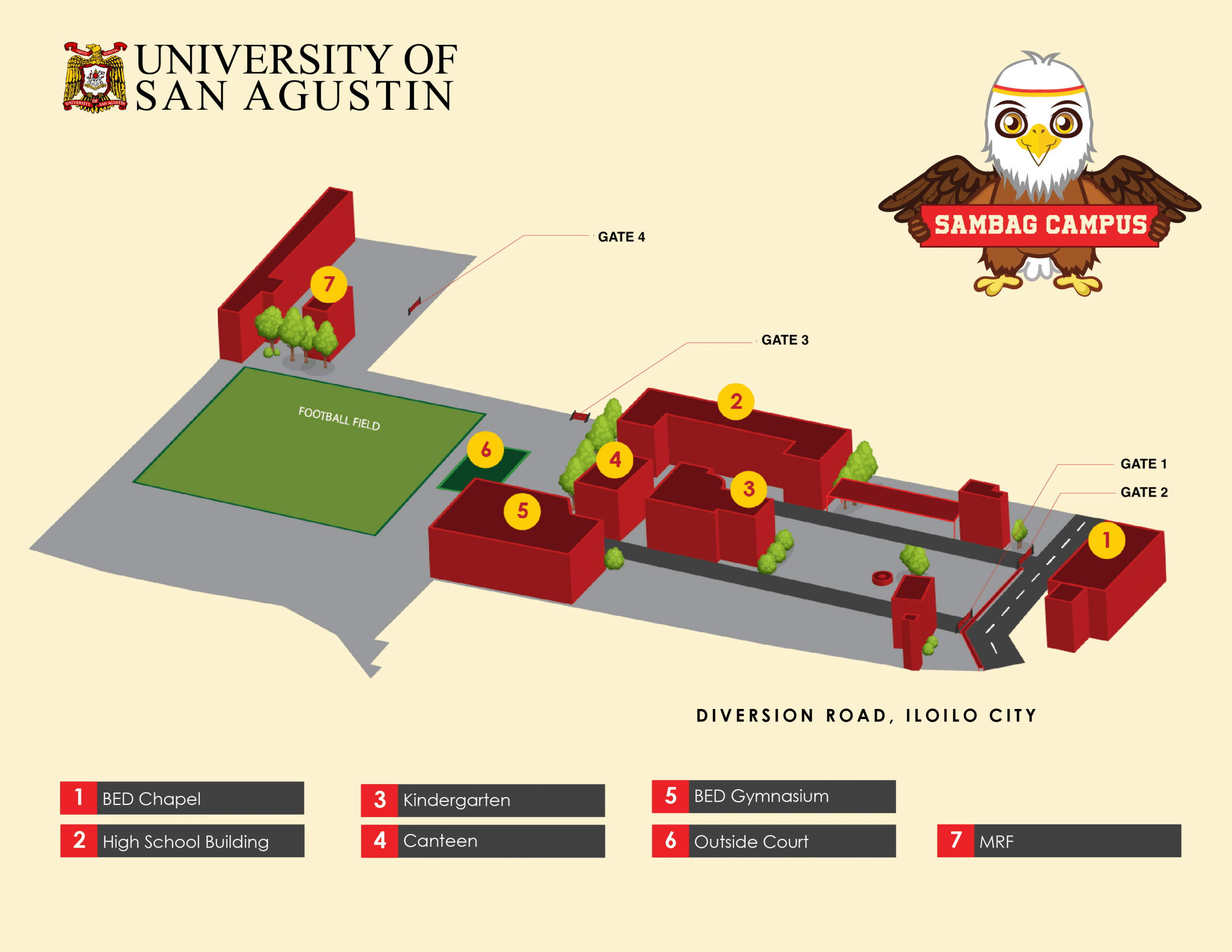
In the 1990s the University became a two-campus university with the acquisition of a site in Sambag, Jaro, Iloilo City. The new campus was developed to house the Basic Education Department, and by that time the student population of the University exceeded 10,000.
The first college to open in the University was the College of Liberal Arts (now College of Liberal Arts, Sciences, and Education) in 1937. It is also the first College to be accredited by the Philippine Accrediting Association of Schools, Colleges and Universities (PAASCU) in this part of the region. Presently, the University has seven (7) colleges: the College of Business (formerly College of Commerce); the College of Criminal Justice; the College of Law; the College of Liberal Arts, Sciences, and Education; the College of Nursing and Nutrition and Dietetics; the College of Pharmacy and Medical Technology; and the College of Technology.
The University’s Basic Education Department offers Nursery, Pre-Kindergarten, Elementary Program, Junior High School Program, and the Senior High School Program offering tracks in Accounting, Business, and Management (ABM), Humanities and Social Sciences (HUMSS), Science, Technology, Engineering and Mathematics (STEM) and General Academic (GA).
The University’s commitment to excellence has been consistently affirmed through various national and international recognitions. Its journey in quality management began in 2016 when the University first achieved ISO 9001:2008 certification. In 2018, the University successfully transitioned to the ISO 9001:2015 standard, and has since maintained continuous certification, with successful recertification audits in 2023 and 2024, demonstrating its enduring adherence to international Quality Management Systems (QMS) standards focused on meeting customer expectations and delivering satisfaction. The University has also transitioned to the more specialized ISO 21001:2018 standards for educational institutions.
The University’s programs have received high-level accreditation from national bodies. Its Teacher Education program has been designated as a CHED Center of Development (COD), a status it maintains alongside a select group of institutions nationwide. This excellence was further recognized when the University earned the inaugural “Excellence in Quality Assurance in Teacher Education (EQUATE) Award” from CHED, placing it among an elite group of just 120 higher education institutions out of more than 1,500 nationwide.
Further demonstrating its dedication to quality assurance, several of the University’s programs have recently achieved prestigious re-accreditation milestones. Seven programs – Bachelor of Arts in Communication, Philosophy, and Political Science; Bachelor of Science in Biology and Psychology; and Bachelor of Elementary and Secondary Education – have been awarded Level III Re-Accredited Status from the Federation of Accrediting Agencies of the Philippines (FAAP) and PAASCU. Additionally, the BS Pharmacy Program has received Level II Re-Accreditation from PAASCU. These accreditations affirm that the programs meet or exceed strict standards for faculty qualification, curriculum, research, and student services.
The University’s contributions to higher education in the region have been consistently recognized by the Commission on Higher Education. At the 4th CHED Regional Quality Awards, the University received eleven awards, including the Outstanding Board Performance Award for a 90.19% passing rate in the Medical Technologist Licensure Examination, and awards for Excellence in Research, Community Extension, Indigenous Peoples Education, and Students’ Affairs and Services. The University was also recognized as a Model Implementer for its student financial assistance programs and the SIKAT system, and received two recognitions in the AUN-QA (ASEAN University Network-Quality Assurance) category, highlighting its international standing. This follows previous recognitions at the 3rd CHED Regional Quality Awards where the University was cited as a Deregulated HEI and received awards for Best in Research, Community Extension, and Student Affairs and Services implementation.
In a significant milestone for its internationalization efforts, the University successfully hosted the 480th AUN-QA Programme Assessment and following this rigorous evaluation, all four assessed programs – Bachelor of Science in Business Administration, Bachelor of Arts in Communication, Bachelor of Elementary Education, and Bachelor of Science in Biology – successfully earned the AUN-QA Certificate, confirming that each meets the highest international academic standards in Southeast Asia. The assessment team commended the University’s “highly dedicated and motivated” faculty and identified its laboratory facilities as “the best in the region.”
The University of San Agustin has also made its mark on the global stage through inclusion in the Times Higher Education (THE) World University Rankings. In 2025, the University debuted in the THE Impact Rankings, landing in the 1501+ bracket worldwide out of 2,526 universities assessed for their contributions to the United Nations Sustainable Development Goals. Following this, the University earned “Reporter” status in the prestigious 2026 THE World University Rankings, officially listing the institution among the select Philippine universities recognized by this globally influential ranking system. The University further improved its standing in the 2026 THE Impact Rankings, advancing to the 1001–1500 bracket worldwide, with its certificate formally presented at the THE Global Sustainable Development Congress in Jakarta.
The University of San Agustin is a member of the Association of Southeast Asian Catholic Colleges and Universities (ASEACCU) and holds the distinction of being the first and only Augustinian university in the Asia-Pacific region. Its College of Law, founded in 1939, hosts the Philippine Arbitration Center in the Visayas (PACV), the only school-based arbitration center in the Philippines and Southeast Asia. In a historic achievement for the College of Law, the Bulahan Price Team won the world championship at the 2026 Monroe E. Price Media Law Moot Court Competition, held at the Bonavero Institute of Human Rights at the University of Oxford. This followed the College of Law’s consistent presence in international moot competitions, including the Philip C. Jessup International Law Moot Court Competition in Washington D.C.
The University’s excellence in professional licensure examinations has yielded a steady stream of topnotchers across multiple disciplines. In 2026 alone, the University produced a No. 1 topnotcher in the April 2026 Pharmacist Licensure Examination, achieving the highest score nationwide (94.65%), while the University itself was recognized as the No. 1 Top-Performing Pharmacy School in the country. This tradition of excellence continued from 2025, when the University celebrated topnotchers across different board exams reflecting the University’s sustained academic rigor and the dedication of its faculty across diverse disciplines.
Most recently, the University was honored as the Institutional Program Awardee at the Uniservitate Awards 2026 – Asia & Oceania for its flagship initiative IPaTUBIG: Empowering IP Community Through WaSH and Renewable Energy. The award recognizes the program’s relevance, sustainability, and genuine focus on community needs, as it provides water, sanitation, hygiene education, and renewable energy solutions to the Guimbal Ati Tribe Organization in Camangahan, Guimbal. Rooted in the Augustinian values of Caritas, Veritas, and Unitas, IPaTUBIG exemplifies the University’s mission of walking in solidarity with marginalized groups.
The Augustinians’ more than one hundred years of felt presence has shaped and re-shaped people’s history, forming persons of faith and character who by their work and example have charted the course of countless other lives, as it continues to serve the Western Visayas Region, the Philippines, and the world.